Wednesday, April 17, 2013
The Case for Perkiness
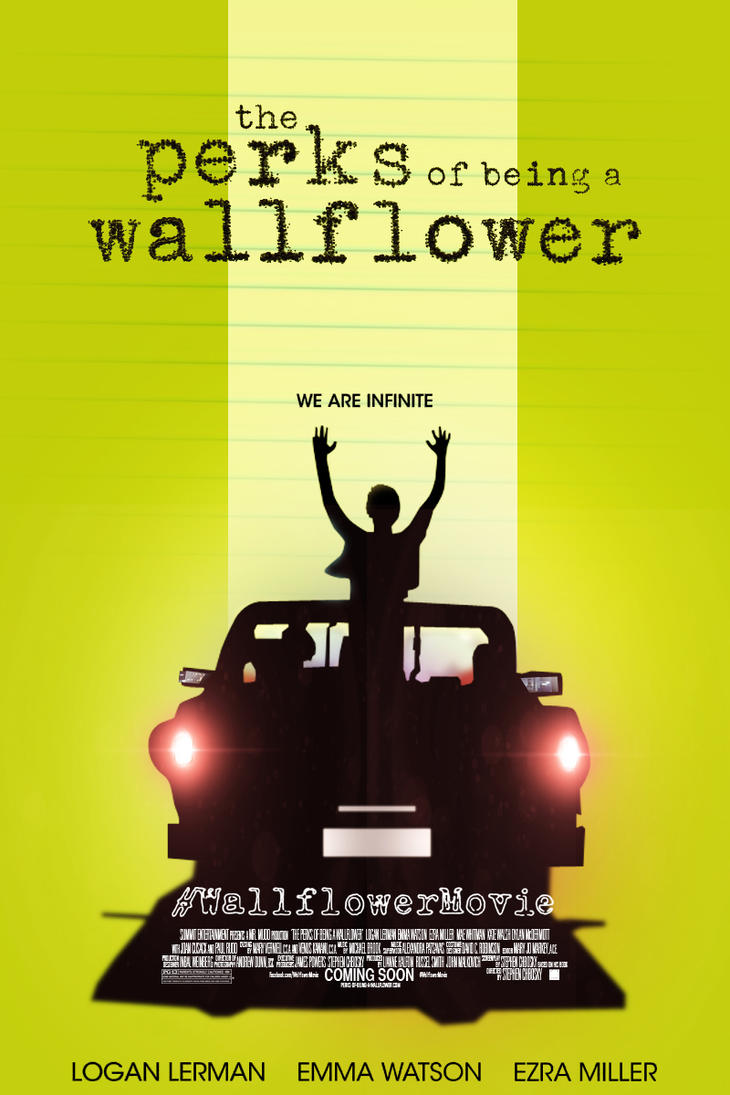
I had not intended to go to Perks of Being A Wallflower originally, until I heard that the cast was absolutely stellar (can’t really go wrong with Melanie Lynskey) and the film itself was really good.
Only one of those is true.
And you can probably guess which by my comment in parentheses.
It’s not that the film doesn’t try. It ticks all the boxes of the coming of age drama, with a loner boy, Charlie, meeting a group of misfits which includes the girl of his dreams, and, to a hip soundtrack, he slowly comes to terms with himself and dealing with his traumas in a very quick and deliberately “shocking” way. School consists of one class, in which Charlie excels, and this is run by the one teacher who just “gets” him – and it was about this stage (admittedly about 15 minutes into the film) that I told myself, “This is just like Donnie Darko! Except… not as good”.
The problem is, everything about the film just tries too hard. The writer of the book on which the film is based is the screenwriter, and the script flows like (in the words of my fellow movie watcher) an unedited slice of life story. The aforementioned teacher, highly influential in the Donnie Darko story, has absolutely no relevance to anything else going on in the film, except to point out that Charlie is bright and likes books. That’s it. The story itself seems set in the 80s purely to allow the film to utilise an 80s soundtrack and namecheck “cool” bands from the era – in almost every other instance (except for the liberal use of mixed tapes), it could be set in the “now” without too much trouble.
Charlie’s brother is, for no reason, a star footballer and his absence and return are of no relevance to anything; Charlie’s sister is completely uneven in tone, her character (and dress sense) varying wildly between star cheerleader (well, she is played by Nina Dobrev) and 1950s Mad Men housewife, hoop skirt and headband and all. Meanwhile, Charlie’s parents are, I think, meant to be strict but fair people, though Dylan McDermott and Kate Walsh are given very few things to do and seem to be told “act grim” for the most part.
Charlie’s friends, given a lot more screen time, are a lot more well-rounded. Ezra Miller, as poor student and completely out Patrick, has the best part and plays his role with gusto (was he really the psycho kid in We Need To Talk About Kevin? Yes, he was! Wow!), and Emma Watson puts on a not always unconvincing American accent to play the gorgeous but not cool object of Charlie’s affection. Charlie himself, played rather well by Logan Lerman, is a bundle of nerves and awkwardness, but he never really convinces as being a different year from his compatriots, has flawless skin (as do they all) and (SPOILER ALERT) completely fails to convey what was so “shocking” about a fight in which he becomes involved – other than the fact he participated, there was nothing about the fight that I imagine would have caused everyone to suddenly stop.
But as mentioned, the cast is impressive, and I imagine that they were all lured onto the project by the prospect of being in a film as “profound” and “socially aware” as Donnie Darko (where even minor characters deserved a huge amount of kudos – remember Noah Wylie and Drew Barrymore in there? I think Melanie Lynskey’s brief appearance as Charlie’s aunt is the only one deserving that much credit here). It’s just a shame the film is nowhere near that good.
And there are shocks. The traumas in Charlie’s life are pretty heavy, though the film seems wary of actually dealing with them or drawing too much attention to them. They are there to be revealed at storyline-relevant moments and to draw gasps from the audience, not really to be issues that Charlie needs to discuss with others or that we need to see being addressed.
There is also a closing monologue before the end credits, which feels very Breakfast Club and really fails to bring things together. Has Charlie made any friends in his own year? Was he put on suspension for getting into a fight, and were his parents ever told? What did happen to Patrick and Brad’s relationship? None of these plot points seem to matter at the end, leaving the “depth” of Charlie’s final speech more paddling pool profound than oceanic.
Of course, it could just have been me. Some in the audience cried out at any shock the storyline threw at them. However, one row of youngsters (teens or early 20s) in front of us discussed with heat some of the storyline points, and not in a positive way. I think it was a sign of the poor writing that people discussed how it failed to all hang together rather than any of the “themes” it was trying to raise.
Verdict: Perks of Being a Wall Flower is a try hard Catcher in the Rye (my learned colleague told me). While the main characters are given a lot of screen time and make a good job of the rather derivative script, the background characters (Joan Cusack!) are there to look serious and get their own Donnie Darko moment – which (except for Melanie Lynskey) never comes. 6 perks out of 10.
Wednesday, April 10, 2013
The Case for Saying Yes to No
It’s a very simple title for a movie: No.
But the film itself is anything but.
The ever cute Gael Garcia Bernal plays Rene Saavedra, an advertising guru who is hired by the “No” campaign in the lead up to the Chilean referendum whether they should continue with Augusto Pinochet as their President (the “Yes” vote). The alternative is for Chileans to opt “No” and return to the days of uncertainty and turmoil prior to the days when Pinochet shot former President Allende and assumed control of the country.
Considering Pinochet’s rule was rife with disappearances and executions, the leaders of the “No” movement, and those associated with them, are understandably nervous about the whole enterprise, and from the outset are dubious that Pinochet will allow anything other than a “Yes” outcome. But while the West supported the coup in the beginning, the international climate has changed, and so, as much as Pinochet and his supporters don’t want to do it, the referendum has to take place. Each side gets 15 minutes a night to make their case and, in the case of the “No” camp, to try and persuade those afraid of the government and the police to actually go out and vote against them.
Pinochet’s campaign platform is simple: his rule has brought stability and wealth to the country (if not necessarily all its citizens), and probably the highest standards of living in Latin America. While Pinochet says he supports democracy, equal rights and votes for all smacks of communism – something the General cannot abide.
The opposition’s view is a bit more fractured, focusing on the torturing and repression of the regime. Sure, city folk have new cars and beautiful clothes and all the modern conveniences, but dissent from the government line is not tolerated. For Saavedra though, the idea is not to focus on the bad that Pinochet has wrought, but to focus on the positives that true democracy will bring.
In one of the most intense scenes in the film (sorry to recap the whole story) is where Saavedra pitches his “Happiness is Coming” campaign to the group and one man, who has lost most of his family to Pinochet either through disappearances or executions or exile, reacts with outrage, feeling the light happy exercise completely undermines the pain and suffering inflicted on dissidents over the years. He walks out shortly thereafter, and it was hard not to feel his anger too. But, at the same time, and in time, Saevedra’s vision, of a positive and (occasionally) light hearted approach to what is actually an incredibly serious and important decision makes a huge amount of sense, engaging those who might otherwise feel too overwhelmed by the injustices Pinochet has wrought.
The battle then is on – whose campaign will win? And what lengths will each side go to for victory?
After a slow and occasionally muddled start, it is a tense journey to the end. Filmed in a very 80s style in square format and with poor (by these days) film stock, it takes a little while for the strange jumps and cuts to stop, and for the viewer to get used to the blurry images and washed out colours. But keeping to period means that the film effortlessly adds real footage from the era into critical scenes, which is a brilliant way to show the real history amongst the acting.
The characters themselves are all fairly good, though it’s the story that is the most compelling piece here. Not compelling enough for more than a dozen people to attend the screening at the Paramount (though the fact it is in Spanish might have put people off too), but for me, it was great.
Verdict: No is modern history retold in a interesting and mostly successful way. Having wandered the streets of Santiago and seen the memorials to Allende and the dead and missing during Pinochet’s rule, it probably had an extra impact on me. But the film shows the power of the media to influence (and coerce) people to make a change for the better (with the help of Christopher Reeve and Jane Fonda of course), and that some revolutions can be peaceful too. 7 rainbows out of 10.
Wednesday, April 3, 2013
The Case for Gee Eyes Too
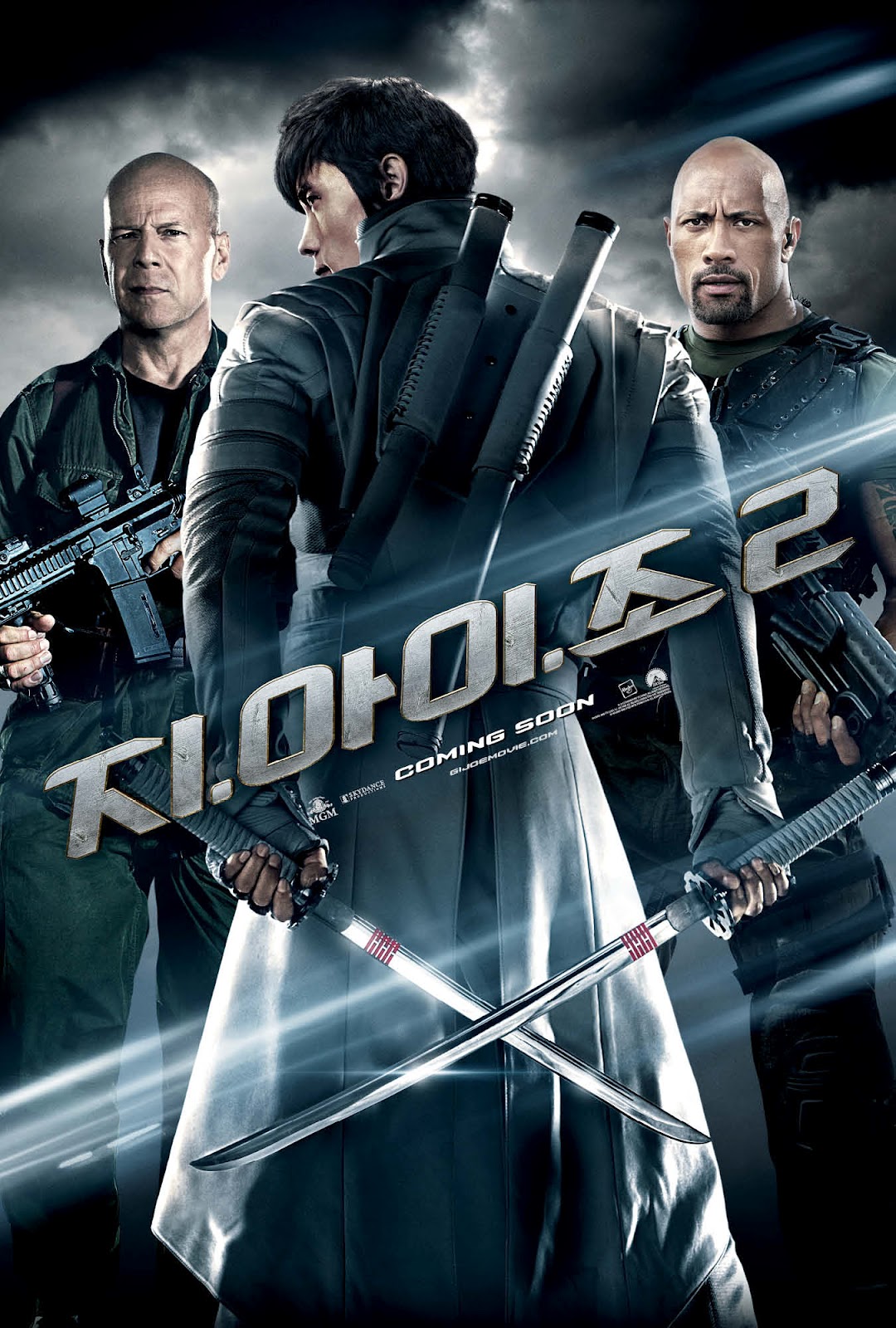
I did not go into G I Joe: Retaliation expecting a masterpiece. The first one was rubbish, but a load of fun, so I presumed I would get more of the same.
And the sequel lived up to that promise, helped in no small part by the ability of Dwayne “the Rock” Johnson (as Roadblock) and Bruce Willis (as a hard-nosed General) to make barely coherent macho characters entertaining (Willis does have off days though, as his powers evidently failed him in the last Die Hard). They both have a knowing smirk and a swagger and seem to be okay with having a laugh at themselves (who would really want to mess with the Rock?) and that translates well in this kind of film where everyone is given very little to work with, so on screen charisma counts a lot towards making a character memorable.
While Channing Tatum as Duke has a back story from the last movie on which to found his character, newcomers Adrienne Palecki (as Lady Jaye) and D J Contra (as Flint) are unable to rise above the material to really make impressions – though from some of the stills that come over the end credits, any interesting parts to their backstories may have ended up on the editing room floor, so it may not be entirely the actors’ faults.
The story, such as it is, is pure macho flag waving nonsense: after violating another sovereign nation’s territory, the Joe team is framed by the evil organisation Cobra and end up on the run. With Cobra intent on taking over the world, the Joe team makes its way back to the United States to try and save their country – and the rest of the planet – from Cobra’s evil clutches.
Amongst all that, there is a side story involving lots of martial arts and the redemption of an evil figure. Unfortunately, the whole thing feels plucked out of a Hong Kong martial arts film (not that there is anything wrong with that) rather than a gun-heavy, bare-knuckle American manly men flick. This particular plotline does itself no favours by having RZA as a pompous blind sensei who tends to spout exposition rather than anything terribly enlightening.
A few spoilers in here: North Korea is the butt of quite a few jokes in this film (makes a change from the French I suppose), though from the looks of it, everyone in the world has the same technologically advanced “suitcase of death” technology, even if the cases themselves are made by different fashion houses. Other things I learned from this film: megalomaniacal super geniuses and their henchmen are kept alive rather than executed, and no expense is spared to keep them that way; with the spare parts from an old 386 computer, one can build a super-fast genetic scanner that has access to every database on the planet; the Rock is contractually obliged to wear an Under Armour spandex muscle shirt in every action film in which he appears (check out Fast Five; no one else seems to be); Israel does have nuclear weapons (though Pakistan does not?); and the destruction of millions of Europeans isn’t as newsworthy as a G I Joe medal presentation.
But it is very hard to complain much about the film, as the silliness and inconsistencies are kind of what I was expecting in the first place. There was nothing that appeared to me worth seeing in 3D (as I went to a 2D session), especially when one lady behind me screamed at almost anything so I don’t think she could have handled anything whizzing by her had she attended a different session. But it was great to see an entertaining Willis (redeemed!) and an always jovial Johnson (he is awesome) and his Roadblock’s not-entirely awkward interactions with Tatum’s Duke. Plus lots of things exploded! Yay.
Verdict: G I Joe: Retaliation seems a bit of a Frankenstein’s monster of a movie, with bits bolted together (and others chopped off) to make a whole that doesn’t look particularly even in tone or pacing, but, given the context of a movie based on a Hasbro toy, kind of works. If the cartoons had plots which made more sense, that’s just because… well, because. 6.5 Yo Joes out of 10.
Friday, March 29, 2013
The Case for Impositions
The fliers for the documentary The Imposter come with a blurb about how it will shock and amaze you and have you discussing the subject matter for weeks. Of course, most documentaries make these claims, as otherwise… well, why would one go?
The subject matter of the Imposter also would seem to make interesting subject matter: a person is arrested in Spain and claims to be an abducted American boy, and the family of the boy comes to claim him, accepts the fact he has the wrong colour eyes and speaks with a French accent, and then take him back home. The immediate questions raised are: how did the family not realise this guy was not the boy they lost? And how did everyone also buy the story?
The tale is mostly told from the perspective of the Imposter himself, Frederic Bourdin, a guy with obviously quite a few issues. In his 20s, he wanted to “belong” in a boy’s home and so posed as a teenager when he eventually made his way to Spain. The Spanish authorities needed to know who he was to keep him in the system he wanted to be a part of, and so he claimed he was an American and then, through a few surreptitious calls to the US (claiming to call his family when in reality he was calling the missing persons line), Bourdin claimed the identity of a Texan child missing for three years.
Back in the US, the family, who also recount the tale from their perspective, rushed to Spain to collect their lost family member. They encounter a boy changed from what they knew, wrapped up in oversized clothing and with a French accent, but believing him abused and in shock, give him the tools to fool the authorities into recognising the family by showing him family photos before his assessment, which also convinces the US authorities to issue him with a passport and take him back to the United States.
It’s all a very bizarre story, and things just get weirder in the US, with television appearances and private investigations and all sorts of weird goings on that I won’t recount here.
However, the intriguing tale is hampered by the fact it is told in a quasi tabloid style. The camera lingers over the faces of people in “moments of reflection” and the imposter himself is given free rein to recount his version of events without ever having to explain what he did and what he thought of those around him. Sure, he had a neglected childhood, but as his past is revealed by the documentary, little to nothing is asked of the subject himself.
And then there is the family. They come across as fairly simple folk from a small town, but as the story progresses and the nature of their blindness to the nature of the Imposter in their midst is examined, the reporting style takes an uncomfortable tabloid tone, and the final scenes where two guys try and “uncover” the truth in a spectacularly staged way are so tacky as to be offensive.
It’s a shame really that the film does seem to devolve into complete trash. The story in itself is absolutely fascinating, and getting all the parties involved and talking should have guaranteed a riveting documentary. But the lack of an “impartial” narrator is where, I think, the film falls down, as the agendas of the people involved seem to take precedence over the facts, not to mention the sensationalism that seems a pathetic way to try and drag the story out.
Verdict: Considering the material, the Imposter itself was a massive disappointment. It had a lot going for it, and the facts themselves make for a bewildering tale, but the style of the telling really let the whole documentary down. Worth seeing for the incredible tale, but possibly with a finger ready to mute some of the nonsense. 6 frauds out of 10.
Saturday, March 23, 2013
The Case for Acting Liberally
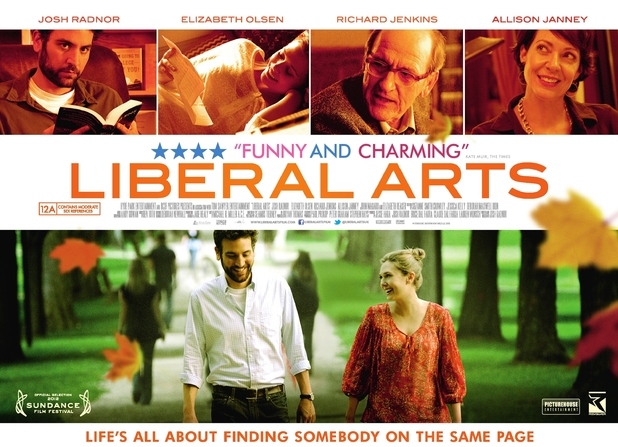
A film that I missed at the Film Festival last year with Josh Radnor's Liberal Arts. As writer, director and star of Liberal Arts, the film really is his baby and all (well most of) the credit for a very charming film goes to him.
Of course, Radnor has a great cast behind him to back him up. Radnor plays Jesse, a guy who has just broken up with his girlfriend and appears generally dissatisfied with life, who returns to the University where he had the time of his life to attend the farewell dinner of his second favourite Professor, played by the ever incredible Richard Jenkins. While there, he encounters three students of note: an idealistic possibly drug addled hippie (played by Zac Efron, amazingly engaging), a tormented literary genius who reminds Jesse of himself (played by John Magaro, who I don't recall seeing before), and a beautiful young student with whom he falls head over heels in love, in the wide eyed doll-like form of Elizabeth Olsen.
From there, the film examines ageing, dating, falling in love, all through the rose tinted glasses of a stunningly beautiful college campus and an always sunny New York. The incomparable Allison Janney strolls in every so often to deliver some dry sass and, as usual, steals every scene that she is in, but otherwise the film is Radnor's (and occasionally Jenkins') and his journey is a lovely, slow and completely understandable one.
There is not a huge amount more to write about this one.e It didn't aim to be classic movie literature (well, I didn't think it was), but it aimed to tell a decent story about a realistic group of people (no explosions nor armies of super-quirky or super-together friends in the background - besides Efron's Nat) and using everyday parts of life - music and books.
Everyone with me at the session was impressed with the movie and walked away with a smile on their face. Of course, at the start, we were subjected to a person unwrapping about one hundred individually wrapped lollies, and having a dickens of a time doing so as well, which had almost everyone else in the cinema bemused/ready to kill him, but in the end, the overall niceness and lightness of the film ensured noone became homicidal and, in fact, everyone probably left in a happier mood than when they walked in.
Verdict: Liberal Arts is a great little film about growing old and finding meaning. Sure, it ends on a very... twee kind of note, but that's okay - this is a rom com afterall. Well done, Mr Radnor! 8 Mothers I Have Met out of 10.
Saturday, March 16, 2013
The Case for Ozzy
Oz the Great and Powerful is every inch the kiddie Disney film.
Perhaps that is not all that surprising really considering it is a prequel to the 1930s Wizard of Oz, and there are lots of nods to movies of that era, with the actors hamming it up a lot of the time and casting aside the subtlety and depth that has characterised many of their performances, and with the film starting in square monochrome and then, as the story shifts to Oz, turning into brilliant technicolour.
The film is visually extraordinary, though disappointingly the wonderful 3D features become, in 2D, a bit blurry and hazy and rather a disappointment. But there are only a few scenes that have been obviously constructed to make the most of 3D technology.
Its pity then that the film starts off rather painfully and slowly then. As much as i think James Franco, Zach Braff, Michelle Williams, Mila Kunis and Rachel Weiss are wonderful - indeed they are the reasons I chose to see the film - I could not get past the very slow and painfully obvious plot as Oz makes his slow and painfully obvious way to the Emerald City and has his encounter with the Wicked Witch.
Quite why he encounters the Wicked Witch in the Dark Forrest, where she doesn't really have a reason to be besides the fact it is an evil place to hang out, is never really explained, nor is how the populace of Oz seems to be ignorant of the nature of the struggle going on around them - until of course the whole nefarious plot has been revealed.
Yep, it irritated me a lot and I was, about midway through the film, convinced that I would hate it and also that the overreactor near me was going to explode if anything cuter than a doll or scarier than an explosion ever appeared (irritating!). However - and yes, this surprised me too - the film kind of redeemed itself.
Once it got past the set up and the story settled in to the battle, it all got pretty exciting and interesting. Mila Kunis stopped being sweet (though she is; did you see that interview with the young BBC reporter?):
As I was saying, she stopped being sweet and started screaming a lot as the action got more intense (though unfortunately she sounded a lot like Meg Griffin to me, which is awesome in itself). Franco didn't stop being a confident, sleazy charmer (he does that so well), and Williams and Weiss get harder and fiercer and their showdown is pretty awesome too.
Overall then, I finished off with a positive experience of the movie. I don't know if I could bring myself to watch it again, considering the beginning, but I can definitely recommend the end. Wizard!
Verdict: Oz the Great and Powerful is not a resounding success, but a bit like the Wizard himself, is a bit of a sham but can make a great show when it brings out the smoke and mirrors. The cast itself is magnificent despite the tortured start of the film, and even with some cloying scenes designed to elicit your sympathy (those always annoy me), it still ends up being a pretty good film. Kind of. 7 Rainbows over 10.
Saturday, March 2, 2013
The Case for a Pause
Hmmn, well the cinematic options at the moment are a bit weak (Movie 43? Hansel and Gretel?) so I haven't really been inspired to go the local cineplex.
But then, there are things that remind me how wonderful movies can be.
Ah, that's... inspiring.
So hopefully I will be back at the movies in the next few weeks.
Verdict: That movie is... something, isn't it? Awesome. 5 whateveritises out of 5.
Subscribe to:
Posts (Atom)


.jpg)