The Way Way Back is a film from the makers of Little Miss Sunshine, and the style and some of the cast (Toni Collette and Steve Carrell) make it all seem very familiar. It’s all very “small” in a family-oriented way, with an awkward teenager who doesn’t quite get on with anyone around him, and there’s an easy sense of humour that surrounds the sadness and discontent at the heart of the movie.
The funny side of things mostly takes place in a water park, where Duncan (the grumpy teen played by Liam James) meets and eventually works for his mentor-slash-saviour, Owen, played with boisterous slacker good-naturedness by Sam Rockwell (is he always awesome?) and with some adults who are all fairly laid back (except for the stunning Maya Rudolph, and I was so disappointed that her character Caitlin and Owen did not hook up, though perhaps that was the point) and seem quite happy to have a 14 year old hanging around with them all the time. As much fun as this is, it’s also the most contrived bit of the film. The way Duncan and Owen meet and bond is all a bit awkward and unnatural (it doesn’t quite have paedophilic air about it, quite) and reeks of misunderstood teen wish fulfilment, and so it doesn’t always work (though Rockwell just has to be let loose to talk random rubbish to entertain).
The real “grounded” part of the film takes place back at home, where Duncan and his Mom, Pam (Collette), and making a go at a summer holiday with Mom’s new boyfriend Trent (Carrell) and his daughter, though things hit a rough patch when the neighbours (Allison Janney in all her faux-drunk, hyper critical and horny glory steals every scene she is in as Betty; Amanda Peet and Rob Coddry are a strangely unconvincing couple) end up spending every waking moment with them too.
Janney’s daughter, Susanna (AnnaSophia Robb), plays a strange (and again unconvincing) bridge between Duncan’s two summer worlds. She is in a bad place due to the divorce of her parents (I think) and so is rejecting her friends (including Carrell’s daughter, a role that kind of just exists to make things awkward at the start of the film and then is kind of forgotten) and being generally grumpy, but is somehow drawn to the uncommunicative Duncan and… well, not much happens there.
I found it an easy mix of two (perhaps three) worlds. First off, there is the very down to earth family life, the serious film component, acted magnificently and brimming with tension and drama and the real driving force behind the film. Then there is the water world theme park, a wonderfully colourful and funny place that has no real driving story behind it and which Duncan inhabits by a set of coincidences so improbable as to be fantastical. Finally, there is the teenage world of awkward in between-ness, where Duncan is kind of expected to hang out with Betty’s son Peter, or perhaps with Trent’s daughter or her friends… but by escaping in to the other two, this world is never particularly well developed.

As the link between all the worlds, Duncan is well played by James, though some of his development through the film is just painful (like the sudden and mysterious appearance of an even, all over tan). He obviously has the awkward but not repulsive look the writers wanted, and handles the family drama impressively well, though when it comes to the bonding with Rockwell’s character, even he has a hard time convincing me of that.
Overall then, the film doesn’t quite ring true. It is funny in parts, serious in parts, implausible in quite a few moments too, and there seem to be a lot of extraneous and irrelevant characters and plot points that add nothing to the film, and perhaps subtract. I suppose they are meant to paint some of the dimensions of the world in which Duncan finds himself, but it just adds to length rather than breadth.
Still, there are lots of amazing performances throughout (can anyone really cry like Collette?) and despite its many flaws, none of them make the film bad – they just make it very contrived and forgettable.
Verdict: The Way Way Back feels like a whole lot of different ideas from different kidult dramadies mushed together into something not particularly convincing. Luckily the cast is impressive and likeable enough to bring the characters to life and to bring humour and tragedy to the scenes that need them, but these are beacons of quality in amongst a foggy sea of mediocrity. 6.5 water wings out of 10.
From Neill Blomkamp, the director of District 9, and starring Academy Award Winners Matt Damon and Jodie Forster, comes a new science fiction experience: Elysium!
And it’s awful.
Sorry, I tried to like it, really I did, and while it started up slowly and built up an interesting world, it slowly became clear that the story made no sense, and that the director was less interested in a movie with Damon and Foster than putting his star from District 9, Sharlto Copley, at the forefront of the film, even if he was an annoying idiot that no one liked. The cinematography is equally irritating, with overly-sentimental flashbacks and slow motion action sequences that do nothing but slow the film’s already fairly glacial pace.
On the plus side, the special effects are amazing.

Now for spoilers – you have been warned!
The story concerns Max (Damon) who for some reason gets doused with radiation (why do the robots need to be radiated again?) and ends up with five days to live. The only cure can be found on the orbiting Elysium space station, to where the rich people fled once the earth became a bit of warm cesspool overrun by Hispanics (there are about two white people besides Damon in California, it appears). Max dons an power suit to make him stronger and accidentally gets his hands on plans to the death star / Elysium that were originally intended to overwrite the programming of the security robots but actually gives whoever possesses it the ability to override and overwrite all of Elysium’s systems (in very easy English speak too). Elysium security chief Delacourt (Foster) sends her South African dirty missions specialist Kruger (Copley) to get the information and from there… well, it gets even more stupid.
Foster speaks beautiful French (I am so jealous) so for some reason she is meant to be French in this film, and so speaks English with a strange accent that is highlighted by some hideous dubbing and the fact she seems to lose this accent later in the film. Damon is stoic and buff and earnest and has almost no real reason to be so determined to get a cure to his condition, but he is an easy leading man to like – so it’s a shame when he is completely sidelined by Copley and becomes almost superfluous to the story, meaning the ending feels completely hollow and devoid of purpose and significance.
My experience was not heightened by a couple regularly talking next to me for the first 45 minutes of the film, quietened only when I gave them the shush sign to let them know that, yes, other people could hear them. Still, even once I had admonished them, the film just continued its downward slide.
On the plus side, I was surprised how early it was when I got out, considering I felt I had seen a movie that was at least two hours long…
Verdict: For so many reasons, I did not like Elysium: terrible storytelling, an inconsistent (or ill conceived) world, awful camera tricks, unconvincing performances, and the hijacking of the focus from the central characters by a side character I really didn’t like anyway. It looked incredible, but could have done with a lot of editing and possibly a completely different director. 4 gated communities out of 10.
Now You See Me is made with a much smaller budget than some of the other films I have seen on a Tuesday evening recently (Pacific Rim, The Wolverine) but despite that, it comes out on top of them for one reason: they are more exciting.
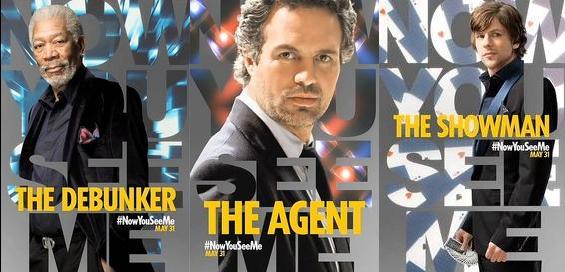
The pace in Now You See Me is fast and furious, which is a great relief as the story makes close to no sense and, when I looked back on the film, I realised there was not one character that I actually liked (well, I liked Morgan Freeman’s character Thaddeus Bradley, but that is probably just because it is Morgan Freeman).
The story concerns a group of magicians at various stages in their career who are brought together by a mysterious force to enact a series of daring acts that bring them to the attention of the FBI and Interpol.

The FBI apparently consists of one terribly inept and continually angry agent Dylan Rhodes, (played by the normally pleasant Mark Ruffalo), and a large building filled with people who have no initiative nor responsibilities. Interpol comes in the guise of a beautiful French woman (the amazing Melanie Laurent from Inglorious Basterds) who has no influence, jurisdiction, drive or even character, though does seem a useful way to get some plot exposition and provide a bit of eye candy.
The lawmakers are up against the lawbreakers of Isla Fisher (charming), Woody Harrelson (charmingly annoying), Jesse Eisenberg (annoying – which seems to be the only thing he can play, so its lucky so many movies need people of this type) and Dave Franco as the foil. We kind of follow these people too, but not really, and then we move back to the perpetually perplexed police.
And that movement is relentless. There is lots of racing around (both of the camera and of the actors) and special effects and shouting as well (which almost always denotes action while of course meaning nothing), and then Morgan Freeman appears to calm everything down and let the audience know that everything is all right.
Though not even his presence can stop the ending from being wildly unsatisfying and relentlessly dumb. Not that it stopped me from enjoying the rest of the film, but how the Four Horsemen’s tricks all work out and the nature of the big grand scheme that motivates everything are all a bit stupid really.
Not that it really matters during the film, which is I suppose, the greatest trick the film pulls off. For all its many, many flaws, it is still a remarkably well executed film, and definitely watchable, though perhaps not re-watchable.
Verdict: Now You See Me is a magic trick in itself – a movie with a whole lot of terrible components all joined together to make a film that is exciting and interesting and a whole lot of fun, even if the end makes you realise quite how much bollocks it all really is. 7 Nothings up my sleeve out of 10.
The final two films in my 2013 Film Fest feast list were ones I approached with a little bit of trepidation, not because they looked at all odd or uncertain, but because I went in with expectations I was a little worried they would not meet.
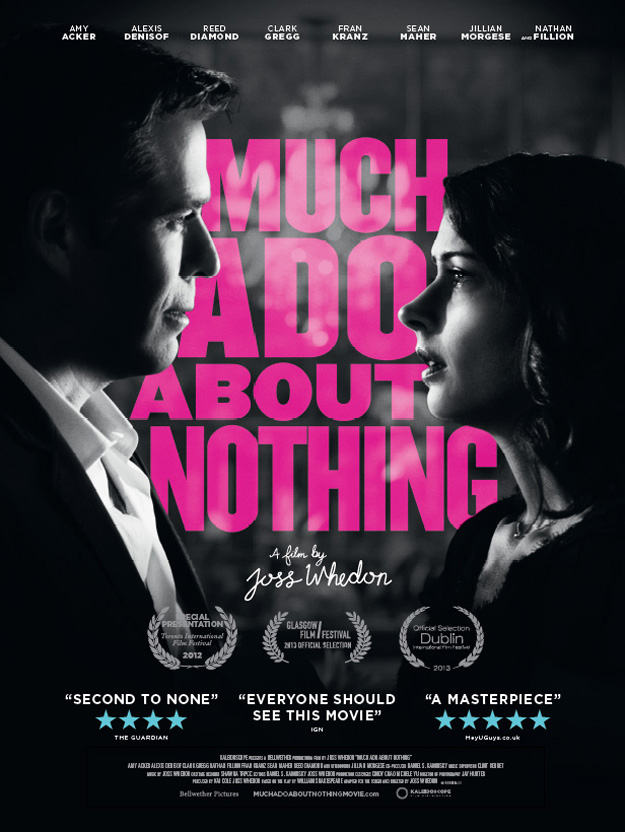
First off was a Friday night Embassy screening of a Joss Whedon film, his rendition (aided and abetted by some of the talented actors he has come across in his many years in film in television) of Shakespeare’s classic, Much Ado About Nothing.
While the setting was Los Angeles (Whedon’s house, I think) and the budget paltry (it was done as a project more than a big budget film, I believe), the lack of dynamism or exotic locations didn’t really detract from the work of the Bard and from the incredibly performances of most (if not all) of the collaborators.
Leading the charge was the stunning Amy Acker, per pencil thin beauty lending itself both to the steely determination and caustic wit of Beatrice as well as the more fragile aspects of the role. As her beau to be, Alexis Denisoff was a little less successful in balancing the anger with the comedic aspects of the role of Dominic, but this may have had more to do with the direction and the script than his performance, and most of his pratfalls elicited a laugh or two.

These two were surrounded by faces familiar and otherwise from Buffy the Vampire Slayer, Angel, Dollhouse, Firefly, the Avengers and other Whedon productions, all speaking Shakespearean prose and obviously enjoying themselves immensely. There are a few bum notes amongst the song, and an atmospheric party scene came across to me as a bit David Lynch-lite, but overall (and once I was used to and thus able to wrap my head around the dialogue), it all flowed well, some of the innuendo in the banter only really noticeable in the hands (well, mouths) of the incredibly gifted cast.
The film was prefaced by a short film called The Captain, shot in the airplane down area of Universal Studios that I had visited earlier this year. I have seen a few shorts as part of my Film Fest experience (Tuffy was another), and I don’t think I really appreciate the form very well, but the budget for The Captain came across as pretty impressive if nothing else
Verdict: There’s not a lot to dislike about Whedon’s Much Ado About Nothing. It may not be all flash and sunny Tuscan fields (it is in black and white too) and the limitations of the size and layout of the house are apparent too (if occasionally used to good comedic effect), but it is fun, well acted, and with a great sense of humour, only part of which Shakespeare intended.
The next day, my final film was another documentary on liberal thinker, Gore Vidal: United States of Amnesia.
I had known a little about Vidal before I went to the film: that he was influential in artistic and liberal circles, that he bemoaned the end of the American Republic and the start of the American Empire, and that he had been around a long time. The documentary showed me how much more there was to the man, both in the size and scope of his circle of friends an influence, but also in the size and scope of his political ambitions. He knew the Kennedy’s well (related by marriage) but was a sharp critic of JFKs record; he made a lot of money in Hollywood but never really considered the television and film industries serious art; he owned an incredible cliff side mansion where he would entertain the Robbins/Sarandon family, with Sting and Bruce Springsteen dropping by at the same time.
As a wit and intellectual, there were a few memorable quotes that punctuated the flow of the movie. But as harsh as some of them sounded (such as “Every time a friend succeeds, I die a little a little”), overall Vidal seems to have had a lot of time for “the common folk”, though not quite as much time as he had for the limelight. Some of his debates during the Viet Nam War are legendary (the tension between Vidal and William Buckley was so palpable I was expecting a brawl to break out on the set), and his view of the American political system did not win him many friends there, though his connections and success meant that his opinions were not completely ignored.

The little Te Papa theatrette was filled with people in the “Upper Middle Age” bracket, and from the way the person decided to mutter under his breath when Obama came on screen and Vidal’s disappointed face reacted to it, it was fairly apparent that the audience for this film was made up of those who shared Vidal’s views (I think I am one of them as well, mostly). It was a little odd when, once again, the finishing of the film brought a round of applause – who was it for, I asked, as Vidal, as a “devout atheist” would not have believed in an afterlife where he could have been viewing and appreciating it.

In any event, the main purpose of the movie was to get me to think, and it succeeded wonderfully. Those thoughts may have been fairly pessimistic, considering the general flavour of Vidal’s ideas, but it was incredible to “experience” the man’s life, and to see how his views were shaped by some incredible people, like his blind grandfather who served in the Senate and ended up poor as he never took bribes, as well as the “love of his life” whom Vidal lost in the Second World War and whose writings from that time seemed to make Vidal bitter with the American government.
Verdict: Gore Vidal: The Unites States of Amnesia is an incredible film really, with interviews with the man himself, and footage from a life that was regularly captured by the media. The title of the film itself was more of a puzzle, with the “American Amnesia” only really concerning a small part of the film, but the film informed and enlightened (or burdened, from a certain point of view) and kept me talking for ages afterwards. 9 Italian hideaways out of 10.
My second filmfest weekend was heavy with teenage angst.
First off, on Friday evening at a sold out session at the Lighthouse in Petone, was What Richard Did., an acclaimed Irish film from 2012. The story follows high school rugby team captain Richard, a good looking guy from a wealthy family with a holiday home by the sea, a huge amount of natural charm and a social nexus, able to easily interact with his parents, teachers, publicans, peers and juniors and become best friends with them all.
Things start to go slowly awry when he becomes infatuated with one of his rugby team mate’s girlfriends. A few carefully orchestrated “accidental” meetings later, and Richard has wooed his love interest to his side, his life changing from one lived with the lads to one of couplehood and, with her ex boyfriend still in the social circle, one tinged with a touch of jealousy.
It takes a long time to get to this point, the dialogue natural to the point of being uninteresting, in that Richard’s charm provokes the interest that his actual words do not. The focus narrows from Richard’s wider circle to his relationship with his girlfriend – and then, at a party, where the unthinkable happens, the focus goes extra tight on to Richard himself, and the character that initially seemed so likable and honourable turns into a bit of an arsehole.
It’s quite hard at this point to judge exactly what Richard is feeling, possibly the intent of the film or a failing on the part of the director and/or actor. Is he upset about his actions or upset for himself? Richard’s relationships don’t really help clarify what is going on either, with his male friends few and far between and his girlfriend a bit indecipherable as well.
Despite some of the ambiguity, the acting is pretty impressive, with Jack Reynor remarkable as the central character. Lars Mikkelsen, playing Richard's Dad, also delivers a moving performance, and those in supporting roles (girlfriend, friends) are more than adequate, though not really given a lot of meaty material themselves.
Unfortunately for me, due to the rather slow pace of the film, I found my mind wandering to Heathers, a film with a similar (though not as earnest) kind of plot, so by the scene in church, I was almost tempted to yell out “ESKIMO!” and see if anyone had the same kind of reaction (I sincerely doubt it).
Nonetheless, the film was incredibly impressive and a tad touching, though in the end, Richard went from someone likable to someone that I kind of wanted to run over in a Humvee – which may have been the objective.
Verdict: What Richard Did is a very potent film, it not as “important” as what some of the publicity claims. It’s too ambiguous for that (what is the message the film is trying to convey again?), but with an amazing performance by Raynor, it is an impressive film nonetheless. 8 beers out of 10.
The second teen-related film was a documentary called Valentine Road, about the shooting of an orphaned latino transgender boy by his budding neo Nazi fourteen year old classmate, all because Larry told Brandon that he had a crush on him, and in class, asked to be called Latoya. Brandon shot Larry twice in the back of the head, having brought a gun to school a few days after Larry asked him to be his Valentine.
Ellen, the ultimate liberal social conscience in America since Oprah abdicated, said it all when, at the beginning of the film, she calls this a tragedy on all fronts. The kids both had hard lives, we discover, and a lot of factors came into play to create the situation.

And then things got me mad, First, the school did not offer counselling to any of the students at the school, including the kids in the room with the two boys when Brandon fired the shots. Next, the teacher in the class, supportive/encouraging of Larry in his search for his identity, was let go. And then… my blood boiled when a coven of jurors came to see Brandon as a victim of Larry’s abuse and (I kid you not) formed a “save Brandon” club to stop him from being tried as an adult, and being convicted at all. Unsurprisingly, the District Attorney and the police representative we were shown were disgusted with the way the victim of the shooting was turned into the guilty party by women who, possibly if the victim were a straight white girl, would probably be out there baying for Brandon’s blood. There is no indication that racism came into play here; the actual implication is that Larry’s orientation was what turned a small boy shot twice in the back of a head into someone who was “asking” for someone to premeditate a murder against him. One teacher went so far to say that Nazi salutes in class were acceptable as “boys will be boys”, whereas of course, boys wearing makeup was just begging for trouble.
And worst of all: the town where all this occurred was a part of greater Los Angeles, not some small town in the Bible belt located next to a nuclear power plant.
Some people in the sparsely populated Film Archive theatre did start crying at one point. The film had its favourites, evident in the use of a “threatening” still of Brandon when most of the video images of him showed that he was a pretty normal looking guy, but of course the film played to my liberal tendencies and some of my more “hanging judge” inclinations as well. Not a perfect documentary, but considering how well it told the backstory of both Brandon as well as Larry, I think it did a great job.
Verdict: Valentine Road shows that people have a lot to learn from last year’s Bully. And that the United States seems a pretty crazy place to live sometimes – I can only hope that New Zealand is a “nicer” place to live in reality as well as in the papers. 9 valentine’s day cards out of 10.
Finally, my evening movie at a mostly full Roxy Cinema was The Spectacular Now, a teenage romantic comedy, in publicity likened to Say Anything, but in reality not that much. An impressive cast of well known faces (if not names) brings together another final year at high school, where Sutter (Miles Teller) is just dumped by his girlfriend but quickly encounters Aimee (Shailene Woodley from The Departed) who, despite his initial intentions, quickly worms her way into his heart. She, in contrast, seems to have always had a crush on Sutter, and so quickly grabs the chance to be his girlfriend, and, apparently, to become an alcoholic.
Films like this confuse the heck out of me when it comes to American drinking laws. I am sure the legal drinking age is 21, but these high school seniors have ready access to alcohol and though all the adults in their lives seem to be aware they are drunk, and some even buy them drinks, no one seems to think that this is a problem or actually illegal.
There is so much drinking in fact that it is sometimes distracting from what is meant to be going on. Sutter finds his Dad (a very un-coach-like Kyle Chandler) and kind of tries to up his grades to graduate, but it’s a bit hard to see quite where this character is going. His girlfriends get directions of their own, and the film seems to be saying that he needs one, but quite where his magnetic North actually points is never really made clear. Friends fade in and out of existence as needed to push the plot, as do adults, but seem to be two dimensional stereotypes for whatever the main characters need at the time, rather than “real characters” with their own lives.
It’s fortunate then that the actors playing Sutter and Aimee are so likable as the leads. They have an easy and sometimes quite believable teenager way about them that, while they are not necessarily convincing as a couple, they are quite believable as actual high school students.
The blurb for this film claimed it was "this generations" Say Anything and I came away completely unconvinced by this. There was no real romance, no moral message, not much of anything really, except perhaps a "shock" moment that is becoming a fairly regular occurrence these days too. However, while the film itself is fairly mediocre, the performances therein are really quite impressive. But I hope there is no sequel. Please.
Verdict: The Spectacular Now was a story with no surprises except perhaps the casual acceptance of teenage alcoholism. However, what really lifts the film are the performances of the cast, who will hopefully move on to other, perhaps more impressive projects soon. 65% proof out of the maximum 100%.
Right, it’s the International Film Festival season, meaning there are more than the usual number of films on my weekly agenda.
The first one was a “biggie”, in that it was featured at the front of the movie guide and was bound to be a big draw card, being the last Soderberg film and featuring Michael Douglas, Matt Damon and a whole raft of well know actors.

Behind the Candelabra is the story of one of Las Vegas piano player and showman Liberace’s longest lasting lovers. Damon plays the hunky Scott Thorson, who is nice but perhaps as dim as Damon’s puppet alter ego in Team America: World Police, while Douglas plays the creepy and controlling Liberace in an incredibly likeable way.
The story is told from Thorson’s point of view (later we learned it was from his memoirs) and so the portrait of Liberace and of Thorson himself doesn’t always seem terribly consistent. True, Liberace appears an incredibly controlling, narcissistic person, but why did Thorson choose to stay with him in the first place if he had no feelings for him, and in fact was a little repulsed by him? Was he really completely naive about his financial situation? And was Thorson’s drug taking accurately portrayed, or did Liberace really have good reason to get upset with him?

The questions though are for after the film. During it, there is plenty to enjoy: from the lavish décor of the Las Vegas residences, to the incredibly overt overtures by the serving staff, to Rob Lowe’s completely scene-stealing turn as a dodgy plastic surgeon who has taken far too much of his own particular brand of medicine, to a cameo by Mad About You’s Paul Reiser as a defeatist lawyer (do lawyers really cave like that in Los Angeles?), to Dan Akroyd’s quiet turn as Liberace’s long suffering manager.
From the list above, you can tell that there are almost no female characters at all in this story. Not that they would have any room to shine amongst all that star wattage. There is plenty of period costuming though, with Scott Bakula rocking a mean cravat in the style of Fred from Scooby Doo, and the feathered hair and glittering stage suits add an outrageously gaudy style to the whole thing.
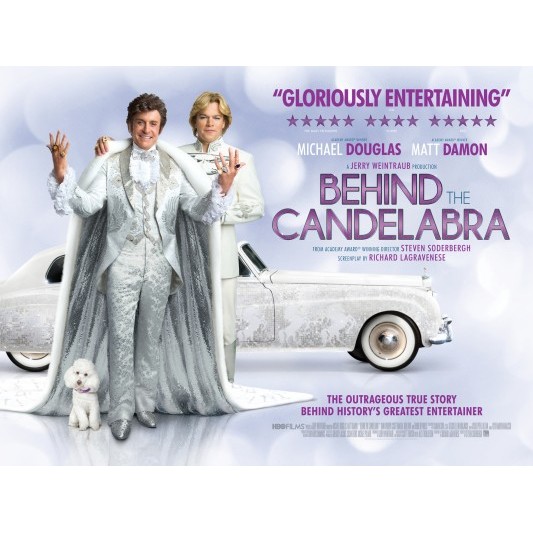
Overall then, the film is a bit on the long side, but always entertaining in one way or another. Some strange camera effects are meant to add to the “drug” aspects of the film but just make it harder to tell what is going on, but despite that, the whole production is (mostly) elegantly and masterfully put together, and it is mesmerising to watch Douglas manipulate and cajole and and reassure one minute and then totally mess it up and be a complete b@sta@rd the next.
Being a “premiere” movie at the Embassy Cinema, I was not surprised to see the theatre almost completely sold out and to hear a smattering of applause at the end to the movie gods who might be paying attention (as no one who helped make the film was there). It is always an incredible experience to go to a film like that with a big audience (who seemed a lot more like members of the art intelligentsia than myself), and it really was the perfect way to start the filmfest season.
Verdict: Incredible turns from Douglas and Lowe, an Matt Damon in various physical states, add extra reasons to watch Soderberg’s Behind the Candelabra, besides the fact it is (in theory) the final Soderberg big screen production. It seems a smaller, more intimate movie that I would have thought (considering Liberace was Mr Showbusiness), but then his Las Vegas venues weren’t that big and it appears he tried to stay out of the big partying scene. It also seemed to be a rather… skewed version of events, but then as Liberace famously denied that he was gay, there is perhaps no way to really get a picture of how he saw his life, and Thorson’s telling may be as close as we will get to the glittering reality. 8 candles out of 10, mainly thanks to Rob Lowe.
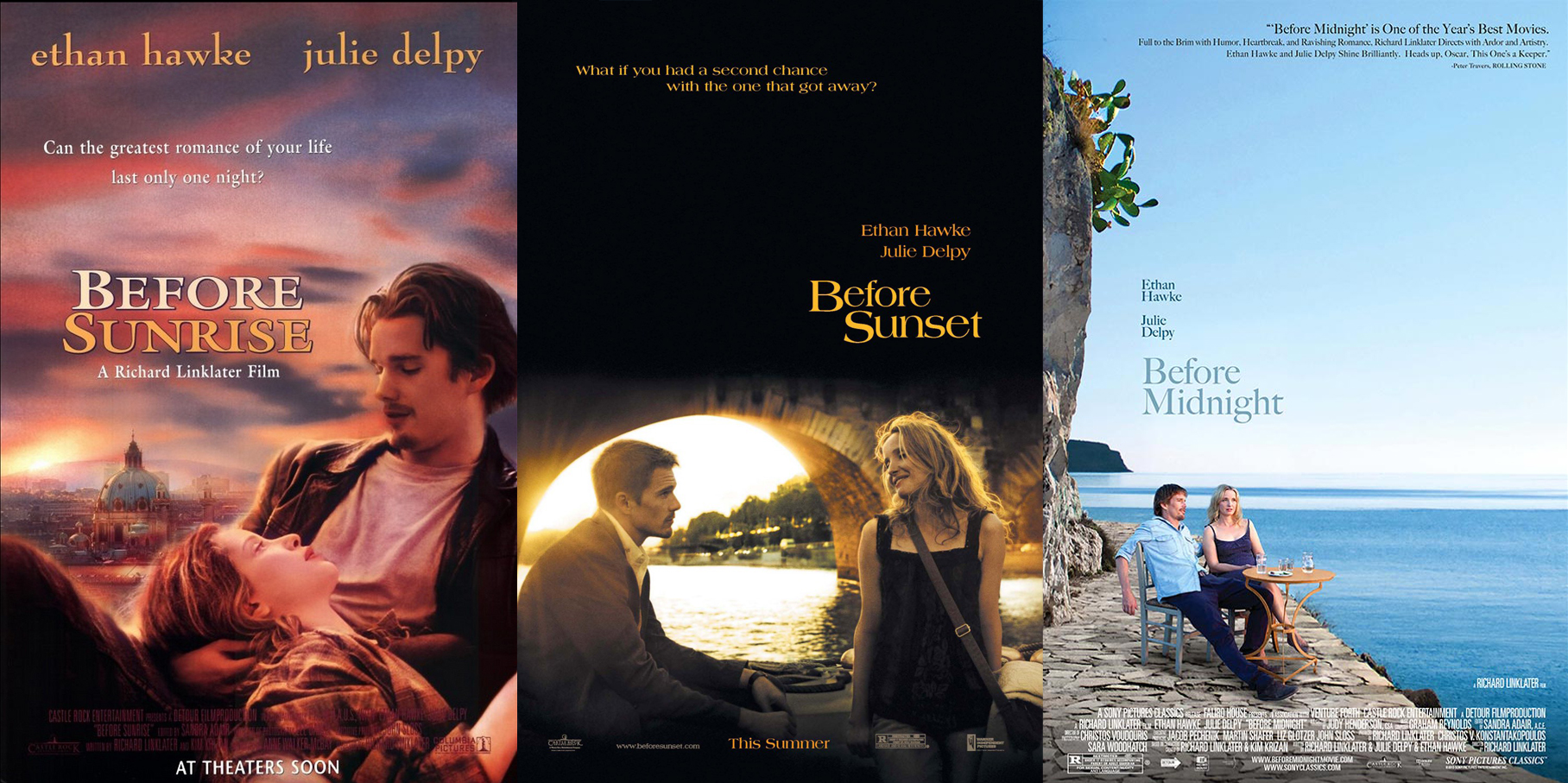
I am a huge fan of the films Before Sunrise and Before Sunset, so of course I had to go to the latest instalment, made 18 years after the original came out.

Before Midnight follows Jesse and Celine and their relationship, picking up nine years after the last film finished. The banter is the same as ever, though the ambiguity of their relationship has gone: they are now together and have been for a while.
It made me a little nervous to think that this time it’s not all about a brief encounter. There was no real need to rush and squeeze a huge amount of drama (well, dialogue) into 90 minutes – surely, living together, they would have the opportunity for deep and meaningfuls (or not so) all the time? The film therefore slowly sets up our two heroes as having a night away from the kids, where they can discuss things frankly and toplessly without the need to tone down their tone for the sake of their little ones’ sensibilities.
And, for me at least, it worked. There is not so much flirtation as tension, and while Celine seems to be on the verge of hysteria at some stages, her reaction to Jesse’s ultra-rational approach is sometimes understandable. There are funny moments and real world problems and some small touching moments as well, all set against the backdrop of a magnificent summer in the stunning Southern Peloponnese.
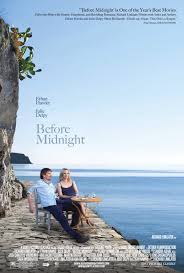
There are also more supporting characters in this film. The couple’s kids, their friends with whom they stay, and even the receptionist staff at their hotel all get to spend at least a little bit of time on screen, some even contributing to some rather lengthy conversations. Everyone is fairly low key, with no mugging or outrageous gestures, though sometimes the interaction around the dinner table seemed a little forced and unnatural, though that was perhaps unavoidable given what the scene was trying to achieve.
Julie Delpy and Ethan Hawke (Celine and Jesse respectively) are perfectly at ease with these roles by now (well, not that surprising considering they help write the dialogue and the story) and also with each other. Delpy’s wandering around half naked for about 15 minutes not seeming at all awkward, while in other films this would be a major event. Hawke has added more lines to his features and still seems to be losing weight, but he plays the nervous Dad and the (occasionally) resigned and hen pecked husband incredibly well.

While some of the friction between the two on this night is developed incredibly well, some of it seems to come out of nowhere, and the reactions to this discord similarly veers from understandable to a bit puzzling. But then, aren’t all relationships at least a little bit confusing to those not involved?
And that is what is great about this film. While the others portrayed the joys and beauty of finding love, Before Midnight goes into the rather trickier territory of showing how a relationship endures and changes over time. And, as you can probably tell, I loved it.
Verdict: Before Midnight once again made me incredibly happy with two of my favourite characters in film. It’s not really about the romance this time; it’s about the relationship, and for the most part, it succeeds in making the relationship between Celine and Jesse entertaining as well as touching. I am looking forward to the next one in nine years’ time. 9 pinball machines out of 10.